




Everything You Need to Know About Healthcare
Running a medical practice requires significant financi...
March 3, 2025




Healthcare providers often need outside funding to buy new equipment, expand their clinics, invest in medical technology, or cover daily costs. But new SBA loan rules make it harder for some clinics to get funding.
From March 1, 2026, the updated SBA guidelines now bring in stricter ownership requirements for businesses applying for SBA-backed loans. Under these rules, even a small percentage of ownership held by an ineligible partner can prevent a practice from qualifying for funding. Moreover, a lot of healthcare practices operate with multiple physicians, investors, or stakeholders, so these changes may create unexpected financing barriers.
As a result, providers are increasingly exploring SBA loan alternatives healthcare practices can rely on to maintain financial stability and continue pursuing growth opportunities.
In this blog, we will examine how new SBA citizenship rules affect medical practice and explore faster, more flexible financing options that can help healthcare providers fund equipment, expansion plans, and working capital needs.
The recent SBA policy updates (1) (effective March 1, 2026) straightaway affect the eligibility of healthcare practices for SBA-backed loans, including the widely used 7(a) and 504 loan programs.
Now, under the updated guidance in SOP 50 10 8, businesses applying for SBA financing must now be 100% owned by U.S. citizens or U.S. nationals whose principal residence is in the United States or its territories. Any level of ownership, be it direct or indirect by non-citizens makes the business ineligible for SBA-backed funding.
This showcases a huge turn from the prior rules. Earlier, businesses were allowed to qualify if at least 51% of the ownership was held by eligible individuals as per the SBA eligibility. And, more recently, a short-lived policy permitted up to 5% foreign or non-resident ownership. But, now, these exceptions have now been fully eliminated.
Key implications for medical practices include:
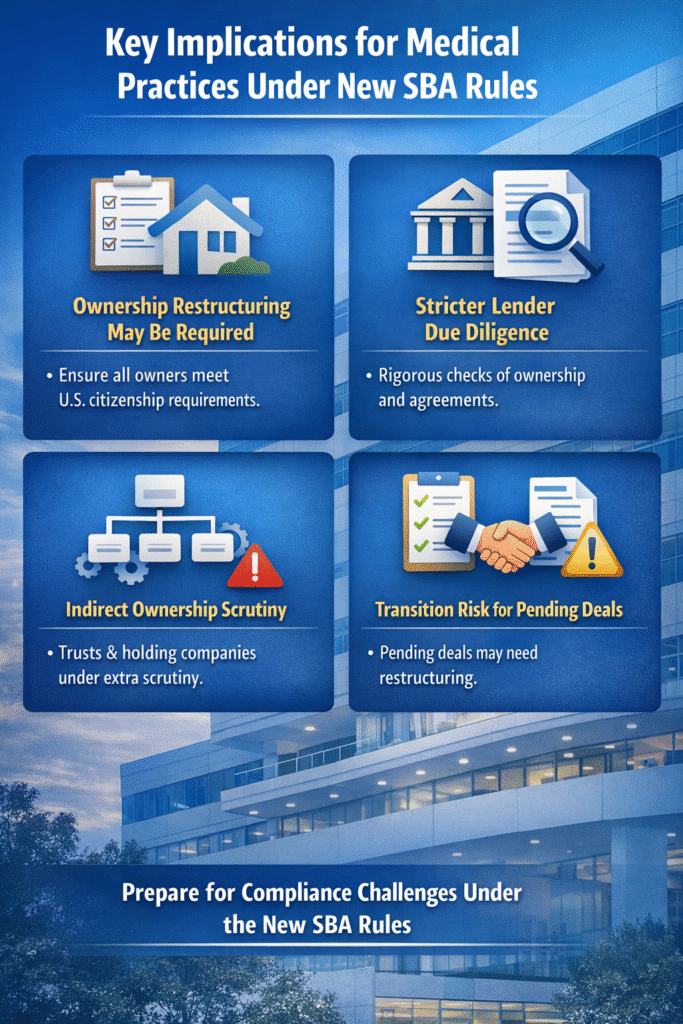
Some of the key reasons for practices seeking SBA loan alternatives in healthcare include:
SBA-backed funding is becoming more restrictive. So, what options help providers access capital amid ownership restrictions? Well, below are some of the most commonly used SBA loan alternatives for medical practices seeking reliable access to funding.
Medical practices frequently need expensive equipment such as diagnostic machines, imaging systems, or specialized treatment tools. Equipment financing allows the providers to purchase these assets without paying the full cost upfront.
In this type of financing, the equipment itself serves as collateral. This can make approval easier compared to unsecured loans. Physicians can spread payments over several years while preserving working capital for operational expenses.
This option is particularly useful for practices investing in:
Another widely used SBA loan alternative in healthcare is term financing, where healthcare providers receive a lump sum of capital and repay it over a fixed period with interest. These loans can be used for a wide variety of purposes, including clinic expansion, renovations, or hiring staff.
Short-term loans are more appealing to organizations that are in a need of quick funding. It’s because approval processes in these types of loans are often faster than SBA loans, and funds can sometimes even be disbursed within days.
However, shorter repayment periods can also lead to higher interest rates or more frequent payment schedules. It is an attractive option for medical practices that are experiencing rapid growth or time-sensitive investment opportunities.
Insurance reimbursement timelines, billing cycles, or seasonal patient demand are all a few factors that can all lead to fluctuating cash flow among healthcare practices. A business line of credit can help reduce and manage these gaps.
A line of credit is different from the traditional loans as it provides access to a predetermined funding limit that the practice can draw from as needed. Providers only pay interest on the amount they actually use. This makes this option more flexible for managing day-to-day expenses such as:
Equity financing is yet another feasible SBA loan alternative in healthcare that allows healthcare providers to raise capital by selling a portion of ownership in their medical practice to investors, partners, or private investment groups. So, instead of borrowing funds and committing to fixed monthly repayments, practices can receive funding in exchange for giving the investors a share of their future profits or equity in their business. It is an attractive option for clinics looking for substantial funding but without the pressure of loan repayments.
For medical practices, equity financing can support several strategic goals:
If you are an established practice with strong financial records and stable revenue streams, traditional bank loans and credit union financing can be an attractive SBA loan alternative in healthcare. This financing type doesn’t offer the same flexibility and speed as some of the other options but can be a reliable access to capital with competitive interests and easy and structured repayment terms.
It also comes with a hidden benefit. Working with banks or credit unions can help medical practices develop strong financial partnerships, which may make it easier to access additional credit or financing in the future.
As SBA lending rules tighten in 2026, ownership restrictions and longer approval timelines are encouraging practices to explore SBA loan alternatives for heatlhcare like equipment financing, term loans, and lines of credit.
However, in this changing environment, it is always the best option to partner with a specialized medical financing company to make the process easier and pick the best option. These lenders are well aware of the healthcare-specific financial needs such as reimbursement cycles and equipment costs. This understanding allows them to offer tailored funding solutions.
At National Medical Funding, we support medical professionals across the U.S. with receivables financing and flexible capital options. With 97% daily payment reliability, a network of 370+ financial experts, and funding often available within hours, we can help healthcare providers secure the resources they need to grow their practices with confidence.
Contact National Medical Funding today and explore the right funding solution for your practice.
Can term or equipment financing replace SBA for practice needs?
Yes, in many cases. Term loans and equipment financing can help medical practices fund clinic upgrades, technology purchases, or expansion projects. These options often provide faster approvals and flexible repayment terms compared to SBA loans.
Can medical startups qualify for financing without SBA support?
Yes. Many specialized healthcare lenders and private financing companies offer funding programs designed for early-stage practices. Approval may depend on projected revenue, physician credentials, patient demand, or collateral such as medical equipment.
Do SBA eligibility restrictions affect multi-partner medical practices?
Yes, ownership structure can influence loan qualification. Practices with multiple partners or investors may face challenges depending on eligibility requirements, making alternative financing options important for maintaining access to capital.
What types of healthcare businesses typically seek alternative financing?
Physician-owned clinics, dental offices, outpatient centers, specialty practices, and medical startups often pursue alternative funding. These practices may need capital for expansion, technology upgrades, acquisitions, or working capital.
Opening a healthcare facility takes careful planning. A...